August 2026
Leaving a Biotech Hub to Help Build One: One Fellow’s Path Into Chicago’s Biotech Ecosystem
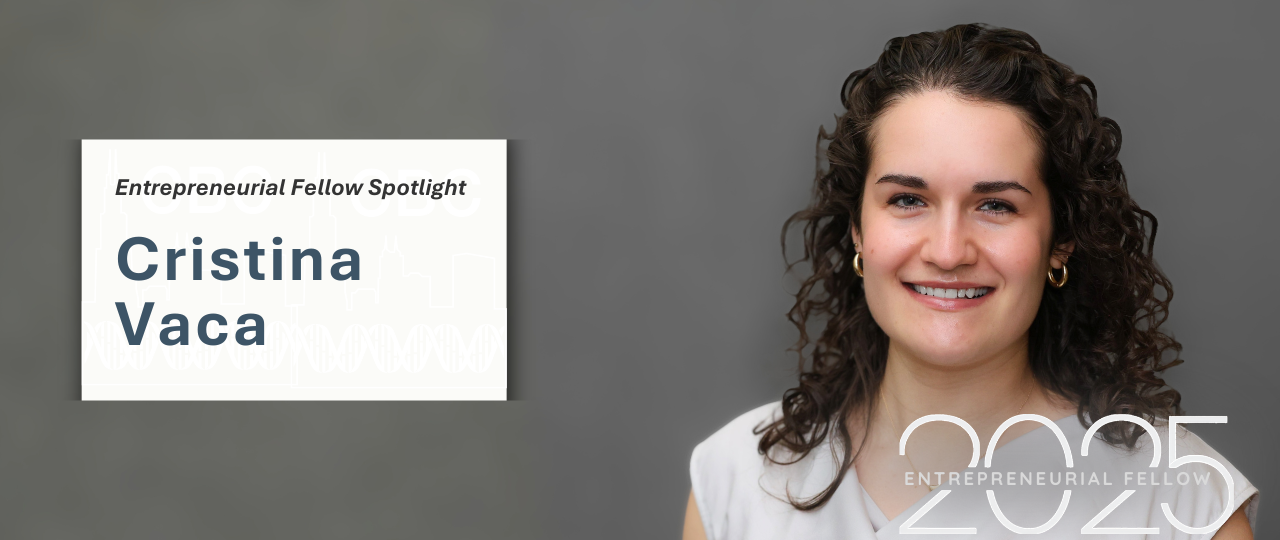
Cristina Vaca grew up in Cambridge, Massachusetts, a few blocks from some of the world’s most storied biotech companies. So close in fact, that a middle school field trip to Biogen, where she loaded a gel with sickle cell DNA, felt almost routine. She loved it. She loved the pipetting, the precision, and the puzzle of it all.
What she didn’t realize until much later was how rare that early exposure actually was.
She recalls classmates who liked science and math telling her, “I didn’t know that doing science research was an option.” . Others who discovered research almost by accident, well into their twenties. For Cristina, unknowingly growing up in a biotech hub meant she knew from the start that a career built around making medicine, not just studying it, was absolutely possible. Her college admissions essay, she says, was about wanting to develop vaccines.
That early motivation pushed her through a biochemistry degree at Penn and into an HIV lab during her Ph.D. in microbiology and immunology at Northwestern. It also, somewhat ironically, pulled her out of the biotech hub she grew up in and placed her in a place with room to build. “It’s kind of ironic that I left a biotech hub to do biotech,” she says.
Finding the Business of ScienceThe pivot away from the bench started with Nucleate, a student-run life sciences accelerator she got involved with in grad school. It was her first real look at how startups form, how founders think, and how difficult it can be to move science out of the lab and into a commercial setting. She noticed that academia tended to reward discovery without much pressure to ask how the market might receive it. She found she loved that translational question more than she expected. By the time she finished her Ph.D., the plan to land a bench science role in California had started to give way to something else entirely: a Chicago-based fellowship where she could stay close to the science while thinking about it through an entirely different lens. That’s what drew her to the Chicago Biomedical Consortium. |
A Different Kind of Ecosystem
Chicago, she says, offered something the coasts didn’t: a smaller, earlier-stage, more collaborative environment where a single person can actually feel their impact. “You’re a small fish in a big pond in one of the coastal biotech hubs,” she says. “But here, I get to help define what a Midwest biotech identity actually looks like, rather than inherit someone else’s playbook.”
Her favorite project so far put her skills to the test: a neuro-splicing modulator, well outside her infectious disease background, and that made her nervous going in. She dug into the mechanism of action, made the case to fund it, and is now working side-by-side with the principal investigator as the program pivots its indication almost from scratch. “I proved to myself that I can learn about a new area quite quickly,” she says, “and then make valuable insights about it.”
Her Advice for Future Fellows
Ask her what she’d tell someone considering the program, and the answer isn’t about credentials or coursework. It’s about translation.
“The presentation you’d make for your dissertation defense is entirely different than the presentation you’d make to apply here,” she says. Applicants coming out of academia tend to over-index on technical depth and under-index on impact, forgetting that their audience doesn’t share their years of specialized context. Her advice: Think about why the work matters, not just how it’s done, and talk to people already in the role before applying, so you know what you’re actually signing up for.
And if you ask her to distill the CBC’s value in a single sentence, she borrows a line from a colleague: the CBC’s industry-level analysis helps catch the fixable problems early, before a founder spends years discovering them the hard way.
It’s a mission she’s fully bought into. Originally from the East Coast, she has no plans to move back. “I am personally invested in the mission of the CBC,” she says, “because I would like there to be an ecosystem for me to work in.”