July 2026
Just Do It: Why an Italian Bio Engineer Came to Chicago and Never Left
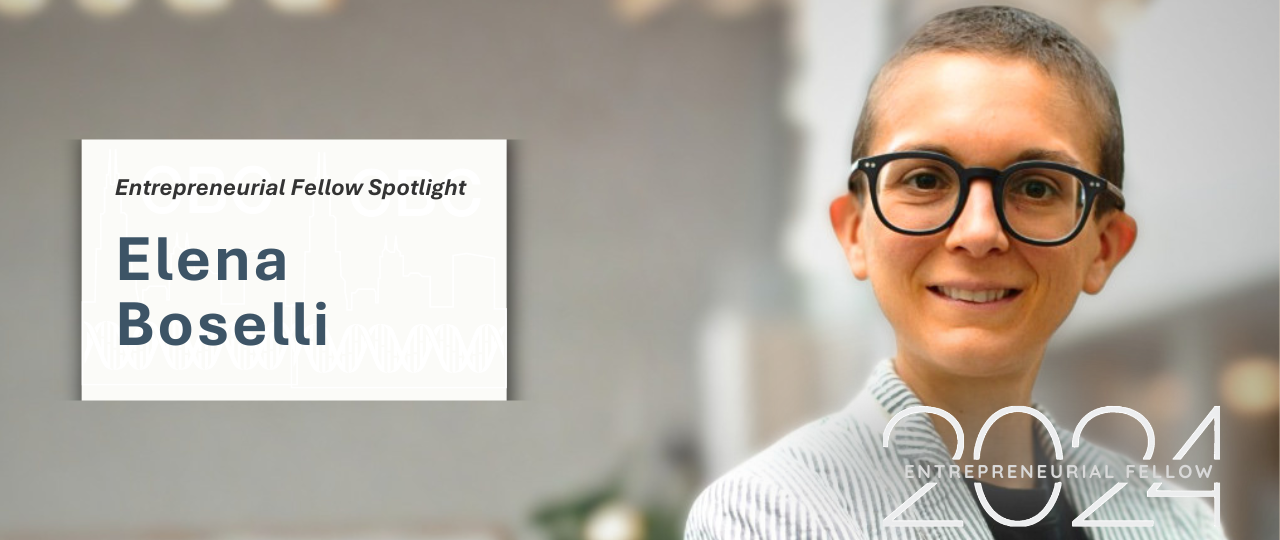
Elena came to Chicago for one year. She stayed because of what she found here; a biotech ecosystem still young enough that the people who show up can actually shape it, and a fellowship program that taught her how.
A biomedical engineer by training, Elena completed her PhD at the University of Illinois Chicago after arriving from Italy through a double-degree program. She first heard about the CBC through a Women in Bio event and a former staff member, then started attending CBC info sessions while finishing her doctorate and talking to fellows from earlier cohorts. The more she heard, the more she wanted in. “The more I learned, the more I became interested,” she says. She applied. She got in. She hasn’t looked back.
Underestimation, But in a Good Way
Elena is candid about what she expected versus what she found: she underestimated the program. Her engineering background was deep in medical devices and sensors. She understood the therapeutic side of drug discovery in theory, but the CBC quickly revealed the reality of the process. “From like day two,” she says, it became clear just how complicated the drug discovery process actually is, not just scientifically, but operationally, commercially, and strategically. “It really shows you all the pieces that have to fall into place to move something from a scientific breakthrough to a tangible, investable product.”
A Full Degree’s Worth from One Experience One of Elena’s sharpest endorsements of the program is about the people inside it. Mentors like CBC leadership Michelle Hoffmann, Eric Schiffhauer, and Liz McMath — The breadth of what the program covers is part of what makes it work, she argues. “It’s built to flex around what each fellow actually wants. If you’re more interested in the deep scientific part, you can hone in on that. But if you’re more interested toward the commercial side, toward the venture capitalist or toward the full entrepreneurship, you have chances to improve upon all of those components.” The track is yours to define. |
The Cohort Changes Everything
Elena didn’t just learn from the curriculum, she learned from the people next to her. Coming in as part of a cohort, rather than alone as an intern might, turned out to be one of the most unexpectedly powerful parts of the experience. “How smart the other fellows are” was something she didn’t fully anticipate, and the day-to-day reality of working alongside people with different scientific backgrounds changed how she approached problems. A casual conversation with a peer could reframe a question she’d been stuck on. A structured working session with the group could crack something open entirely. “Having sort of like a mirror with someone else, especially coming with a different background, always brings a different edge,” she says.
Committed to Community and Collaboration
Elena shared that her time as an EF has reshaped how she thinks about her career. She describes herself as someone who has always been pragmatic, drawn to roles that blend strategy with execution rather than living purely in scientific depth or purely in business strategy. Her ideal next step: leading operations across one of biotech’s ecosystem hubs, helping multiple programs identify the milestones that matter and the most efficient operational path to reach them — minimizing cost, time, and resources along the way.
Outside of work, that same instinct toward community-building shows up in her involvement with Women in Bio, where she helps expose early-career professionals to the soft skills and realities of biotech that academia rarely teaches. And when she’s not doing that, you’ll likely find her biking around Chicago, camera in hand, documenting the city’s street art.
Three Simple Words of Advice
Elena’s advice for anyone thinking about applying is three words: “Just do it.” Then she backs that advice: learn to be comfortable with the uncomfortable, and be resilient and adaptive. She’s not talking abstractly. She means that the program will put you in rooms and on problems where the path forward isn’t obvious, where Plan A will fall apart, and where your job is to find your way to Plan B, C, or Z. That’s not an accident. That’s the training.
Asked to compress the value of the CBC into a single sentence, she doesn’t hesitate: “Skill in the game in how to make biotech visions investable and impactful.”
It’s a line that sounds like a mission statement, because it is one, hers and the program’s both.