June 2026
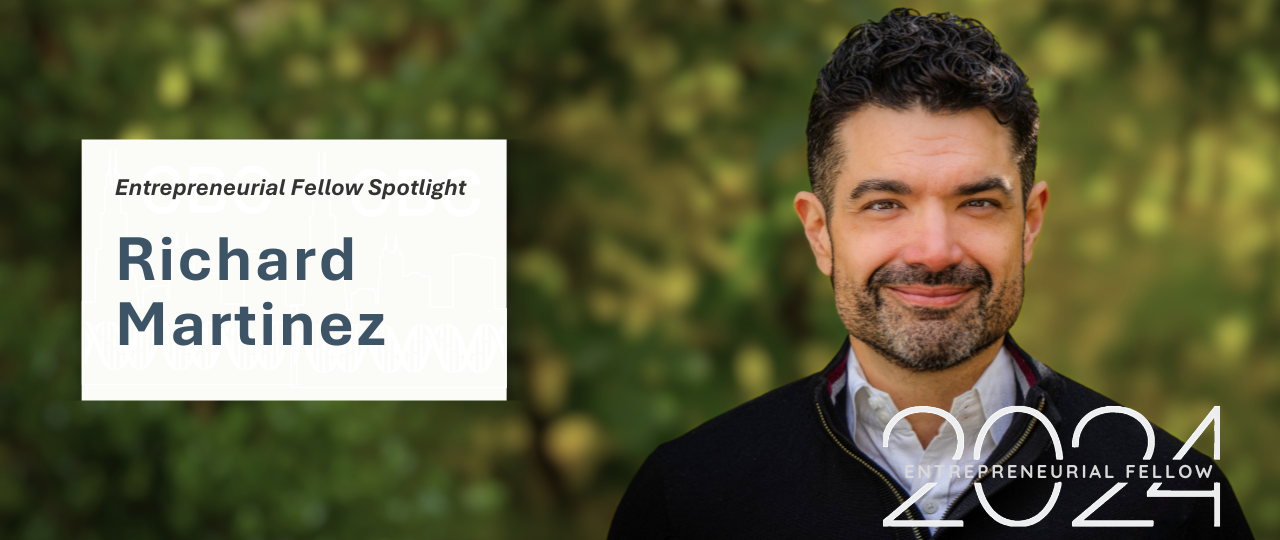
The Risk Worth Taking: Richard’s Unique Path to Find His Place in Translational Science
Most people in biotech can trace their path back to a university lab, a mentor, a formative class. Richard’s starts somewhere different: a deployment to Afghanistan.
He decided not to go to college out of high school. He worked jobs he describes simply as “bad,” joined the Army Reserve, and ended up overseas. It was there that something clicked. He decided he wanted to go to school when he got home, not because someone told him to, but because for the first time he knew exactly why he wanted to.
“I wanted to be an MD. Medicine really interests me. So that’s what I did.”
A lot of people enter PhD programs in biomedical science because it was always the plan, the next step after the last step. Richard chose it from the other side of a much harder experience, which might be part of why he’s never taken the opportunity for granted.
What happened once he got into school was a genuine surprise. He discovered that he loved research, specifically the wave of microbiome science breaking in the early 2010s, and the idea that there were more bacterial cells in your body than human cells and that had to be affecting everything.
“That’s what got me into my PhD, and what got me into translational science in general.”
He ended up in a microbiology lab at the University of Minnesota, doing work with real clinical implications. But somewhere toward the end of his graduate work, he started getting honest with himself about something: he didn’t want to stay in the lab forever. He wanted to be closer to the bigger picture, but he didn’t have a clear path to that.
Then his former labmate Alex gave him one.
Shooting his shot and reaping the rewardsAlex had finished his PhD a year ahead of Richard and come back to Chicago to join the CBC Entrepreneurial Fellowship. By the end of grad school, Alex had been burnt out. Richard watched the transformation from a distance. “He had glowing things to say about the CBC and all the stuff he was doing, which was a great shift in him. To see him so excited about what he was learning and doing at the CBC really made me want to apply.” Richard applied to exactly one program coming out of his PhD. The EF program at the CBC. “Thankfully, I got in.” His expectation walking in was that evaluating biomedical research for commercial potential would be somewhat binary; good science leads to good medicine, and you figure out which is which. |
“There are so many facets to the evaluation of biomedical research and innovation, and each of those facets has its own strategies and its own interpretations of what is translatable and what’s not,” he says. “It takes an analytical mind, a scientific mind, but also a very creative mind, to be able to say, where does this puzzle piece fit? Could it fit? And how can we shift the shape of that puzzle piece to fit into what’s growing and what’s needed?”
The thing that’s really stuck with him is how often promising science fails for reasons that have nothing to do with science. He’s seen it in competitive landscapes and in the histories of drugs that never made it to patients.
“They ran out of money, or they were acquired, or they went bankrupt before they could show convincing data. It’s not scientific. There’s a whole sliding doors conversation you can have about what could have been with some of these technologies.” He pauses. “That has really embedded itself in my thinking about the value that EFs can add by helping some of those things that might not have made it before to reach the clinic, or at least giving them a fighting chance.”
Expanding the possibilities through experience
Through externships with organizations including Xentria, Lurie Children’s, and COUR Pharmaceuticals, Richard has spent time seeing how CBC-built skills hold up in the real world outside. The answer, he says, is that the EF training mirrors real industry expectations and standards.
“You get this sense that you could walk in here and not be the most junior person. I would come in with skills I can directly and immediately add value with.”
One thing he genuinely didn’t see coming: His love for regulatory strategy. He would have laughed at the suggestion during his PhD. But the EF program has a way of expanding what you think you care about. Spending real time in the drug development pipeline showed him how much can change based on factors that have nothing to do with the science and how rarely those factors get the expert attention they deserve. That’s the career he wants to build: going deep on the non-science side so the science has a real shot.
Organize to survive and find the risks worth taking
If you’re thinking about applying to the EF program, Richard’s advice is practical to the point of being blunt.
“Make sure that you have a system in place for organization and time management, because those systems and skills are going to be tested.”
The science, the business concepts, the evaluation frameworks; there’s a learning curve, but you climb it. The harder thing, at least for him, was keeping everything organized while managing multiple projects, partners, and deadlines at once. It’s something he is still actively refining.
“That’s an evolving conversation with myself. Is this the best way? Always trying to make it better.”
The return on the investment, he says, shows up in real moments. The week of this interview, he was at a networking event and ending up in a deep conversation with a director from Procter & Gamble — someone with twenty years in the field. They talked as peers.
“It’s only because I have those skills, this experience from the CBC, that I was able to have that conversation at a high level.”
When he’s not working, Richard is watching movies or deep in a film podcast, the kind where people argue seriously about cinematography and studio economics. It’s his way of switching off. Except it doesn’t quite work.
“They talk about de-risking,” he says. “There’s this whole conversation about how movies have become so homogeneous; studios want to appeal to four quadrants, make their money back on $200 million. But then you have something like Sinners or Everything Everywhere All at Once, and on paper those are risky. You always have to find a risk taker sometimes.”
He reflects, “And that translates to what we do, too.”
For someone who took the long way into this field, through odd jobs, an overseas deployment, a PhD, and one well-placed phone call from a former labmate, maybe that’s the point. The risk paid off.