May 2025
Building the Bridge: How One Scientist Found Her Way Home and Into the Future of Drug Discovery
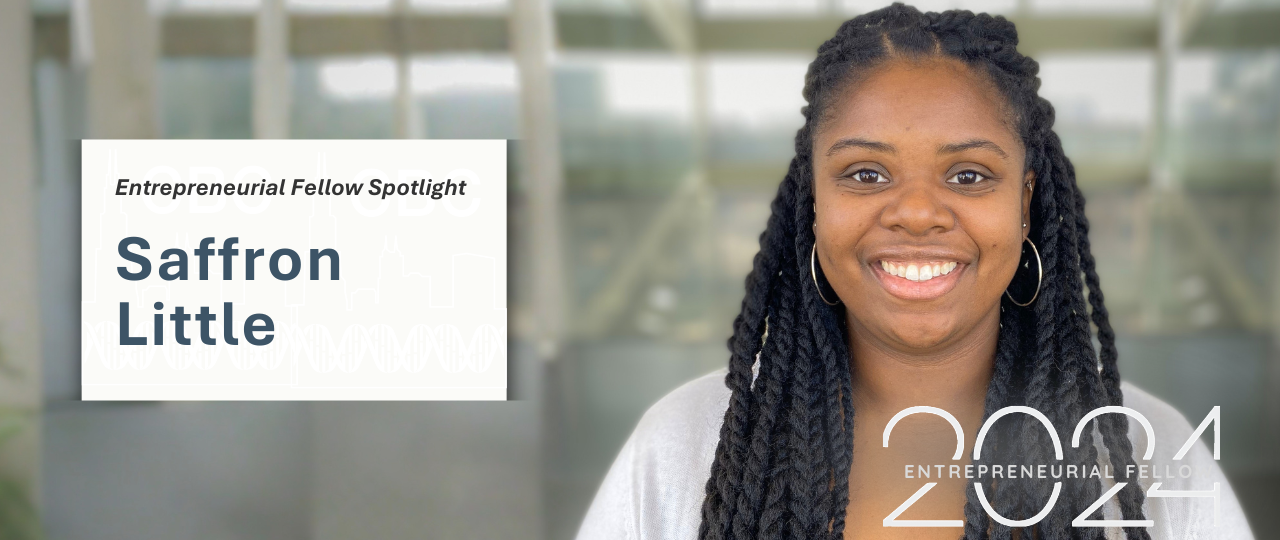
Saffron always knew she wanted to be a researcher. Growing up in Chicago, the thrill of scientific discovery was always top of mind, and so she did what serious scientists do: she left home, earned her PhD at the University of Michigan, and spent twelve years in the focused world of cell biology.
But somewhere along the way, something shifted.
“I wanted to see the science in use and more in practice,” she says. “I want the things that I’m discovering to actually help people.” Pure bench science, as rewarding as it was, felt like only half the story. She wanted to see what happened after the discovery.
A conversation with someone who knew the Chicago Biomedical Consortium’s Entrepreneurial Fellows (EF) program changed everything. “This was completely new to me, completely foreign — I don’t have any experience in the entrepreneurship world, or the business world, or drug discovery,” she recalls thinking. The program’s promise of an expansive expert network was compelling. But there was one more thing that sealed it: the program was in Chicago. After twelve years away, she was ready to come home.
What she found surprised her.
Saffron had some peripheral awareness of how innovation evaluation programs worked, but nothing quite prepared her for the depth of the CBC’s connections to real industry. The “experts” the program advertised weren’t just academics with opinions. They were people who had worked at Novartis, Back Bay, Deerfield, and had done hands-on search and evaluation at major biotech firms.
“I just didn’t realize what that really meant, and what that really looked like,” she says. “Their knowledge was so expansive and really opened my eyes to the possibilities in this field.”
Equally surprising was the CBC’s reach across the entire Chicago biotech ecosystem. She’d known it as non-profit within Northwestern. What she hadn’t anticipated was how pervasive its presence was. Walking into companies across the city, she’d hear: Oh, I know someone from the CBC. Oh, I’ve heard of you all. New players trying to break into Chicago’s biotech scene would come to CBC for guidance. “We are the ones telling them, ‘You should go here, you should look here, you should check out Portal,'” she says. “I didn’t recognize our reach beyond the university.”
The rigor and pace of the work were another revelation. “I recognized a level of excellence that reflected the high standards the industry expects of this work. Also, everyone was a little more aware than I was,” she laughs. “I was like, okay, I know nothing, and that’s okay, because the team is getting us up to speed very quickly.”
Finding the discovery spark again.Among the many projects Saffron has worked on, one type has become her favorite: those mid-stage projects right at the cusp of formulation, where a target is validated and the team is figuring out exactly how to build the therapeutic. It brought her back to her undergraduate roots in chemistry, to structure-activity relationships and optimizing drug-like properties, to the hands-on intellectual puzzle of figuring out how a molecule becomes a medicine. “A lot of times we’re not the scientists in the lab doing the science anymore,” she reflects. “I feel like that discovery part is in my hands and exciting again.” The experience also changed how she thinks about science at large. She used to see it as a linear process: step A leading to step B leading to step C. Now she understands it as dynamic, unpredictable, and shaped by many moving parts that need to be coordinated in order to progress. “If you’re not innovating and thinking of new ways to approach problems,” she says, “then what are you even working toward?” |
The event planner of the scientific world.
Ask Saffron what she would do if she weren’t in science, and she doesn’t hesitate: event planning.
“I want to do the event planning of the scientific world,” she says with a laugh, “which feels like drug discovery.” What she means is project management, being the person behind the scenes who coordinates all the moving parts, who handles the logistics and strategy so that when the show goes on, the drug gets to be the star. “That’s where I shine most: the logistics, the coordination, the strategy. And that’s what I see as my next step.”
The EF program helped her see that. Early on, she pushed back hard on frameworks that didn’t seem to account for real-world complexity. Her CBC mentors kept redirecting her: there are other factors, there are other considerations. Slowly, she came to understand that flexibility wasn’t a weakness in the strategy; it was the strategy. Drug discovery program management is now clearly in her sights, and the EF program gave her the strategic exposure to see it.
Her advice? Stay open.
For scientists considering the EF program, Saffron’s guidance is direct: come in with an open mind, and don’t be afraid of what you don’t know.
“There will be a lot of different things you’re going to be put on, a lot of different things you’re going to have to explore,” she says. You might arrive with a niche specialty and thrive within it. Or you might arrive uncertain of your direction and discover an entirely new one. Either path works, but only if you’re willing to ask questions, sit with ambiguity, and let your thinking evolve.
The cohort experience, she adds, is one of the program’s most underrated gifts. Her cohort of eight came from wildly different scientific backgrounds, and that diversity made all of them sharper. “Few people know I have a background in X-ray crystallography,” she says, “so when people start talking about that as part of their project, I can say, ‘These are things I’ve seen.'” But when a subject like oncology, where she had little experience, came up, she was able to lean on another fellow who’d spent years in that world. They really were able to create a network where they could learn from each other and optimize each individual’s strengths for the greater good of the team. “I think working with the people here has been one of the most beneficial parts for me because they have exposed me to information that I wouldn’t have known if I was working in isolation.”
Engineering the bridge over the Valley of Death.
If you ask Saffron to sum up what the CBC does in a single image, she reaches for an something that captures the construction happening behind the science.
“We are engineers of a sort,” she says. “The Valley of Death has seen a lot of therapeutics go there to die, and we’re the ones constructing the bridge in order to help bring these innovations over to the people.”
Someone pours the concrete. Someone measures the distance. Someone understands the risk. “We got to get a little dirty, get down in the trenches in order to help some of these early-stage projects flourish.”
And the EF program itself? It’s what brings scientists out of the lab and into the world more conversational, more collaborative, more aware of the full arc from discovery to patient. “It really helps create a more holistic, well-rounded scientist,” she says, “where you’re not only investigating a very niche project, but you’re also interfacing with all the people and processes that help bring this product to life.”
For Saffron, that’s exactly what she came home to Chicago to find.