August 2026
From Small Town to Startup Science: One Fellow’s Case for Chicago Biotech
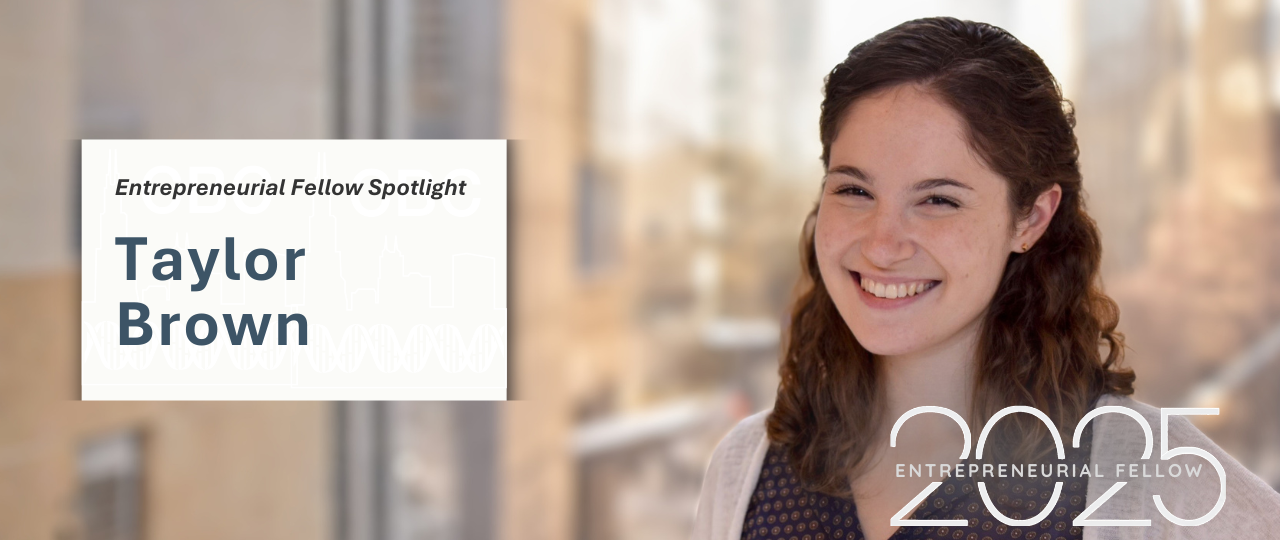
Growing up in Petoskey, Michigan, population roughly six thousand, Taylor learned early that community isn’t something that just happens to you. You build it. That instinct followed this Northwestern-trained biomedical engineer all the way through a PhD in regenerative engineering and into the CBC’s Entrepreneurial Fellows program, where she’s spent the past year learning that the same principle applies to an entire ecosystem.
She knew she wanted to be a biomedical engineer in eighth grade and spent the next decade building the skills to do it seriously. Bachelor’s and PhD at Northwestern, both in biomedical engineering, specializing in how the body regenerates itself and how to design therapeutics that recreate those processes. The science was fascinating. It was also very early stage.
“I was really hoping to get more experiences around actually translating those discoveries into therapeutics,” she says. When she learned that the CBC had a program explicitly designed to bridge academic discovery and clinical impact, the next step became obvious. The EF program wasn’t a detour from her path, it was the next logical destination on it.
The Pleasant SurprisesShe’d been in the Northwestern ecosystem long enough to have heard of the CBC and crossed paths with a few fellows. She thought she knew what she was getting into. She was partly right. Some of what she expected when she started was true: deep skill-building in translating science from academic labs into real products. What she didn’t see coming was just how much room the program creates for professional development beyond managing scientific experiments. Conferences. Externships with companies. Lectures from people working in roles she’d never heard of. “Those were all things I sort of learned once I got here,” she says. “A pleasant surprise when I arrived.” The biggest surprise, though, came about two months in during the first triage review of the fellowship. Her PhD training had been in vascular regenerative engineering. Her first project was in colorectal cancer. “Something I had read about,” she says carefully, “but really had no experience with.” She was Googling techniques for the first time. |
Six to eight weeks later, she was actively contributing to the project. “I was surprised at how quickly I was able to actually have an impact.” Part of that was her educational foundation. Part of it was the freedom the EF program gave her to learn in her own way. And a significant part of it was the cohort around her; fellows who’d done their PhDs in oncology and could tell her in ten minutes whether an animal model was standard practice or something a single PI invented in their own lab. “Having the other fellows to lean on,” she says, “is one of the pieces I like the most about being here.”
The Project That Clicked
The work she’s most excited about is in the cardiovascular space, and it’s where she’s been able to operate as a project manager, which is where she sees her career heading. The central task was a comparator analysis, mapping approved and unapproved products against their own to help define what “good enough” actually looks like for what they’re building.
It was nerve-wracking, she admits, doing deep independent research alongside PIs with twenty-plus years of experience and CBC directors who’d seen hundreds of programs. But getting to sit with the work, develop a real point of view, and then bring that to the table in substantive conversations with senior people in the field, that was the whole point. “It was really exciting to see what came out of the dedicated and collaborative effort on that project.”
The experience also clarified something she hadn’t fully realized before: she wants to stay close to the clinical problem and the science, while getting to make bigger-picture strategic calls. Chief scientific officer at a startup is the long-term dream. Project manager, medical affairs, scientific advisory are all the doors she can now see clearly, doors she didn’t know existed six months ago. “Working here has definitely shown me a lot of these other opportunities,” she says.
The Skill Nobody Emphasizes in Grad School
Ask her what she’s heard from senior fellows about what actually makes people valuable in industry, and she doesn’t talk about scientific chops. She talks about people skills. “Even when there’s a science problem, there’s usually also a people problem you’re dealing with on top of that.” Managing teams. Running communication across a project. Navigating the human dynamics that don’t show up in papers or protocols. “These are the soft skills that are so important to science and aren’t always emphasized in our training before.”
The EF program, she argues, gives you real reps at exactly this skill set, whether it’s interfacing with PIs from different labs, coordinating across research organizations, or learning to use the same language as a regulatory specialist or a consultant even if you’ll never be one yourself. That cross-functional fluency, she thinks, is what makes a future scientific leader actually useful to a team.
Building the Ecosystem from the Inside
There’s a line of thinking that runs through everything Taylor says about the CBC, and it connects directly back to her upbringing in Petoskey: Chicago biotech is a community that people here are actively choosing to build. “A lot of us want it to the level of the bigger coastal hubs, and I think that does create more of a community feeling,” she says. “Midwest friendliness and collaboration” isn’t a stereotype she’s dismissing. It’s something she’s observed as a real competitive advantage in how people here do science together.
She sees the EF program as a direct contributor to that ecosystem-building project, especially through what she calls the “education piece,” meaning the knowledge fellows carry back into their own academic networks, the materials shared with PIs, the classroom visits at local universities. “Just sharing the knowledge that we’re getting, because it is a unique experience that we’re having.” That part doesn’t always get talked about explicitly, she says. She thinks it should.
When she’s not in the office, she and her husband host a weekly board game night, an extension of the same instinct that shaped her science career. Community is something you build, deliberately, one connection at a time.
Her Advice
If someone asked her whether to apply, she’d start with a homework assignment. “Really take time to think and dream big about where you want to go in your career, and then map the specific gaps. The skills you haven’t had the chance to build. The people you haven’t had access to. The experiences that won’t come from staying in a lab.”
Because the way to get the most out of the program, she’s learned, is to arrive already knowing what you’re there for. “It really is most useful when you take the time to take that initiative.” The sooner you start thinking that way, the better, and she’d argue the place to start is in the application itself.
How does she describe the EF program? “The ability to bridge academia to industry, and while you’re doing that, gaining incredible skills and really getting to be a hands-on leader in the field really early in your career.”
Two things. Both true. Neither available anywhere else quite like this.